are we evolutionarily wired for comfort?
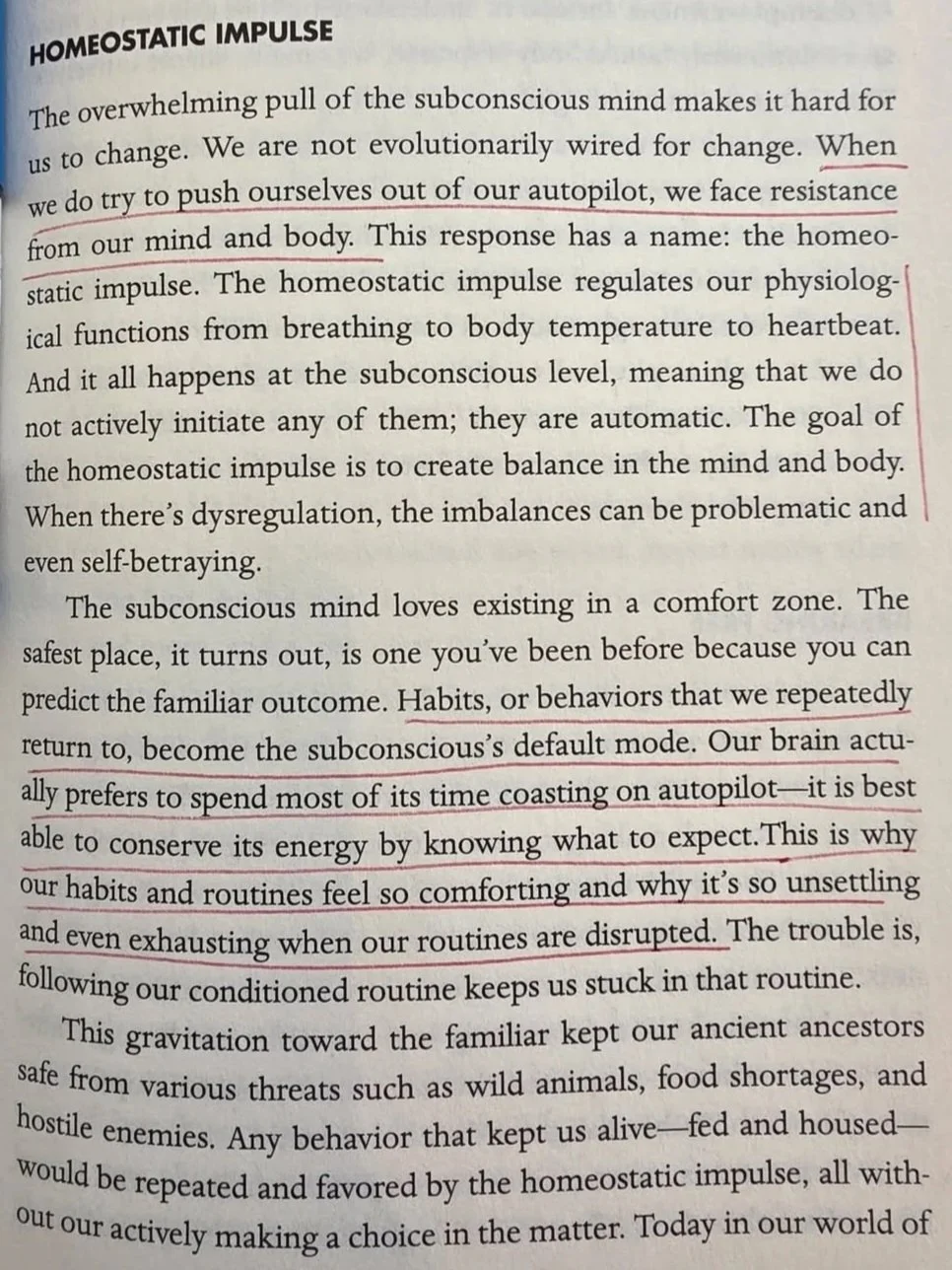
If you read the passage on the "homeostatic impulse," the basic idea makes sense on the surface. There is clearly something in us that prefers relative ease, comfort, predictability, and familiarity. Routine lowers friction. Familiar patterns reduce uncertainty. Habit makes life easier to manage. That part isn't had to understand. Where I would push back is no the stronger claim that this is simply how we are inherently wired, as though human beings fundamentally only want comfort and resist change by nature.
I don't think that is fully accurate. If we inherently wanted comfort above all else and had no real impulse toward novelty, exploration, or expansion, we would have never made it out of the swamp in the first place. We would have stayed with whatever was easiest, safest, and most familiar. Human history doesn't look like that. We explored, migrated, built, experimented, fought, created, and pursued things far beyond immediate comfort. So it doesn't make sense to say that humans only want comfort. That's far too simple.
What makes more sense to me is that we are wired for energy efficiency, threat reduction, and pattern stability much of the time, but we are also wired for novelty, reward, challenge, status, meaning, and expansion under the right conditions. Those are not contradictions. They are both a necessary part of who we are and how we got here.
The subconscious mind likely does prefer the familiar in the sense that the familiar is metabolically cheaper. Prediction reduces uncertainty. Repetition lowers cognitive demand. Habits automate behavior so the brain doesn't have to keep solving the same problem from scratch. In that sense, autopilot is real. But that isn't the same thing as saying that humans fundamentally want comfort above all else. It's more accurate to say that the organism values efficiency and survivability.
The distinction that feels missing in this passage is the difference between baseline regulation and higher-order motivation. At the baseline level, the body wants stability. That is what homeostasis is. Temperature, respiration, blood sugar, hydration, and other physiological functions benefit from relative predictability. Sudden disruption can feel stressful because the system has to spend energy adapting. That part is true.
But at the behavioral and psychological level, human beings clearly do not seek comfort. We also seek stimulation, growth, competence, mastery, discovery, admiration, meaning, and progress. People willingly endure discomfort for those things all the time. Hard training is uncomfortable. Starting a business is uncomfortable. Falling in love is destabilizing. Leaving home is uncertain. Adventure is risky. Yet people pursue all of it. Not because they want comfort, but because they want something they find more valuable than comfort.
So the deeper truth isn't that humans are wired for comfort. It's that humans are constantly negotiating a balance between security and expansion. Too much instability and we pull back towards safety. Too much sameness and we start craving movement, novelty, challenge, or change. That feels much closer to reality than saying we're all simply wired for comfort.
A better way to put it would be this: humans are wired to preserve stability, but not to remain stagnant. We conserve energy through habit and familiarity, yet we're also driven to pursue novelty, opportunity, and meaning when the potential reward feels worth the uncertainty.
That also explains why different people chase novelty to different degrees. Some people have a higher appetite for uncertainty, risk, exploration, and stimulation. Other are more strongly pulled toward routine and predictability. Temperament matters. Life experience matters. Trauma matters. Resources matter. Confidence matters. Someone who feels safe may seek challenge. Someone who feels chronically threatened may cling more tightly to control and sameness.
So my issue isn’t that the “homeostatic impulse” is entirely wrong. It’s that it overstates one side of human nature. It takes resistance to change and treats it as proof that we’re fundamentally built for comfort, when in reality resistance to change may simply mean that change carries a cost. And that isn’t the same thing as saying humans don’t want more. Clearly we do. Human beings don’t move toward what is easy just because it’s easy. We move toward what feels worth it.
What is probably more true is this: We default toward comfort, but we are also drawn to what feels worth the discomfort.